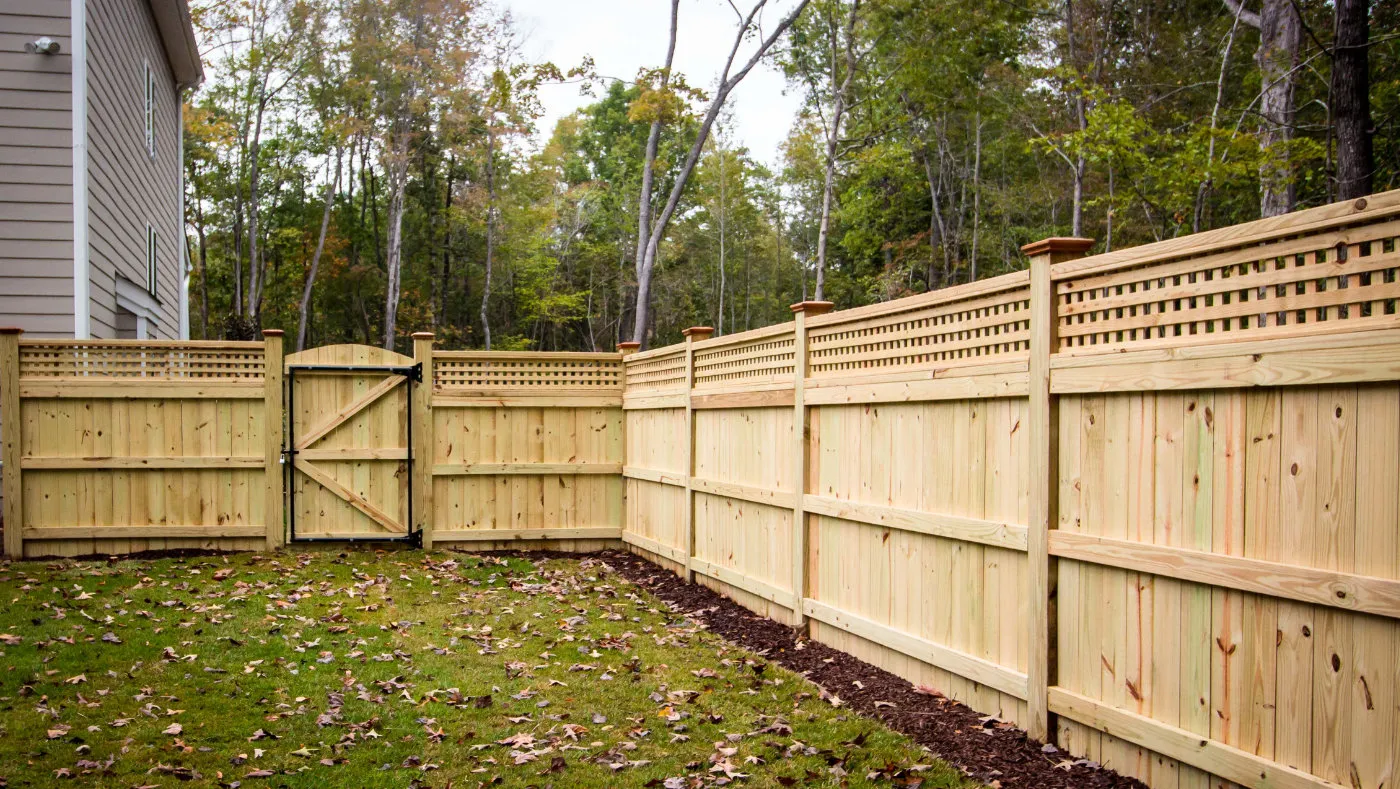
Wood costs less up front. Vinyl costs more on day one and then asks for very little. National 2026 ranges are $20 to $50 a foot for wood and $30 to $60 for vinyl, both installed.
The dollar figures here are national ranges that HomeGuide published for 2026. They are not quotes from The Fence Company of Boston. Local labor, material prices and the conditions on your lot move the real number up or down. Figures last checked October 2026.
How the two compare
- Upkeep: wood wants stain or sealer every few years. Vinyl wants a hose and a brush.
- What fails: wood rots, starting at the posts. Vinyl can crack if it is hit hard on a very cold day.
- Fixing it: wood is mended one board at a time. Vinyl damage often means a new panel.
- Appearance: wood takes any stain color. Vinyl comes in a short list of factory colors and stays even.
- Long run: staining and repairs narrow the price gap as the years pass.
Should I pick cedar or pressure-treated pine?
| Cedar | Pressure-treated pine | |
|---|---|---|
| Price | Higher | Lower |
| Rot and insects | Resists both without treatment | Protected by the treatment |
| Shape over time | Tends to stay straight | More likely to twist as it dries |
| Best use | Boards and pickets | Posts and framing |
Mixing them is common: treated posts in the ground, cedar where you see it.
Which fence lasts longest in a climate that keeps freezing and thawing?
The one with the deepest posts. Frost is harder on footings than on panels, so a shallow post shortens the life of any material. Beyond that, vinyl and aluminum cannot rot, which gives them an edge. A wood fence keeps up when its boards clear the ground and its posts reach below frost.
Which fence is best for my yard?
- For privacy: wood or vinyl at 6 feet. Solid panels take a lot of wind, so post depth counts.
- For a big dog: chain link, wood or vinyl at 5 to 6 feet, tight to the ground.
- For small children: a solid fence and a gate that latches itself, with the latch out of reach.
- For a pool: vinyl or aluminum made to the pool barrier code. The gate hardware gets inspected.
- For the lowest price: chain link, with slats if you want screening.
- For little upkeep: aluminum or vinyl, at a higher starting price.
- For a historic street: ornamental metal or wood, after design review.
Is aluminum fencing strong enough to hold a big dog?
In most cases it is. Strength is rarely what lets a dog out. Jumpers clear a low fence, so pick a taller one. Small or slim dogs slip between pickets, so choose a style with tighter spacing near the ground.
We own a large dog, want privacy and have a tight budget. What should we build?
Start with treated pine at 6 feet. No other solid fence costs less, and that height stops most big dogs. Then trim the footage. Put the solid fence where neighbors or the street look in, and run chain link along the stretches that face woods or a back lot.
The neighbor wants matching wood and a split bill, but I want vinyl. What then?
A fence on the shared line can only be one thing, so one of you has to give way there. Settle the material, write down who pays what, and sign it. Other sides of your yard can be vinyl regardless. If no deal is reached, you are free to put your vinyl fence a few inches inside your boundary and pay for it alone.
What will the fence look like from my neighbor's side?
It varies by style. Shadowbox wood and the majority of vinyl panels look alike front and back. Stockade and ordinary picket fences show posts and rails on one face. Check your local code, since many municipalities want the good face turned outward.
Want a price for your own yard? The estimate is free, done on site, and the quote comes in writing. Call (508) 690-4738.